The Sunday Morning Delivery
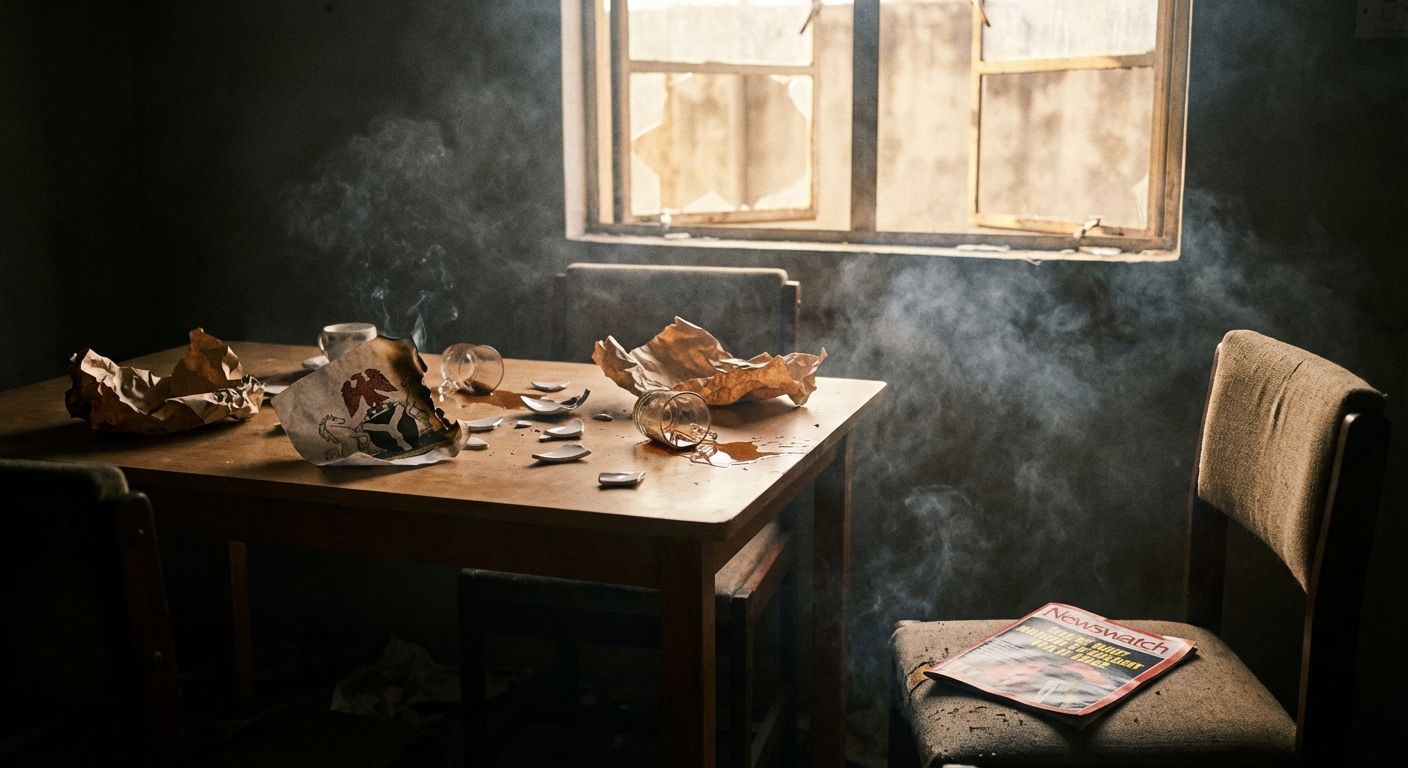
It is a Sunday in Lagos, the kind of morning when the city exhales. October 19, 1986. The harmattan has not yet arrived, and the air in Ikeja hangs heavy with humidity and diesel exhaust from the generators that never stop humming. On Talabi Street, in a modest home that nevertheless hums with a different kind of energy — the energy of a man who has made powerful enemies — Dele Giwa sits at his dining table.
He is not alone. Kayode Soyinka, a fellow journalist and friend, has come to visit. They are talking shop. The conversation turns to what it always turns to in the orbit of Dele Giwa: the next story, the next confrontation, the next issue of Newswatch magazine, the publication that has reshaped Nigerian journalism from a government stenography service into something that makes generals lose sleep.
A package arrives. It is addressed to Giwa personally. It bears the seal of the Nigerian coat of arms — the eagle, the black shield, the motto. This is not unusual in a country where official communications routinely arrive by hand. Giwa takes the package. He places it on his lap.
Soyinka excuses himself to the restroom.
The explosion blows out the windows. It tears through Giwa's midsection. When Soyinka staggers back from the bathroom, temporarily deafened, he finds his friend collapsed, eviscerated, the breakfast table destroyed. Giwa's last coherent words, spoken to those who rush to help, are reported as: "They got me."
He does not say who "they" are. He dies in hospital later that morning. He is thirty-nine years old.
The Man Who Changed Nigerian Journalism
Dele Giwa was born on March 16, 1947, in Ile-Ife, the spiritual heartland of the Yoruba people in southwestern Nigeria. He was educated at the University of Lagos and later attended Columbia University in New York, where he studied journalism. He returned to Nigeria with American ideas about what the press was supposed to do — not merely report what the government said, but challenge it, verify it, and when necessary, expose it as a lie.
In 1984, together with Ray Ekpu, Dan Agbese, and Yakubu Mohammed — four journalists who had grown weary of working within the confines of government-aligned publications — Giwa co-founded Newswatch magazine. The timing was deliberate. Nigeria was under military rule, as it had been for most of its post-independence history, and the press operated under varying degrees of censorship and intimidation. Newswatch was intended to be different. It was modelled on Time and Newsweek but with a specifically Nigerian fearlessness. It investigated corruption. It named names. It published photographs and documents. Within two years, it had the largest circulation of any news magazine in West Africa.
The publication's relationship with the military government of General Ibrahim Babangida was initially cordial. In its first months, Newswatch put Babangida on its cover four times. But the honeymoon was brief. As Giwa and his team dug deeper into the operations of the regime — the financial arrangements, the intelligence services, the personal enrichment of officers — the tone shifted. The magazine became a target.
In early 1986, an edition of Newswatch was banned. Copies were seized from newsstands. The message was clear. Giwa did not stop.
The Interrogation
In the weeks before his death, Dele Giwa was summoned to the headquarters of Nigeria's State Security Service, the SSS. The interrogation was conducted by Colonel Halilu Akilu of the Directorate of Military Intelligence. The stated pretext was an allegation that Giwa had been overheard discussing arms importation with unnamed contacts — a charge so vague as to be unfalsifiable, and so serious as to justify indefinite detention under military law.
On October 16, 1986 — three days before his death — Giwa was questioned by SSS officials over the telephone. On October 17, his colleague Ray Ekpu accompanied him to SSS headquarters for a face-to-face interrogation. Lieutenant Colonel A.K. Togun accused Giwa of plotting with the Nigerian Labour Congress, the Academic Staff Union of Universities, and student groups to carry out what he described as a "socialist revolution." Giwa denied the charges.
The interrogation lasted hours. Giwa left shaken but defiant.
There is a detail that emerges later, one that has never been satisfactorily explained: on the eve of the murder, Colonel Akilu reportedly telephoned Giwa's wife to ask for directions to their home.
The Gloria Okon Thread
For decades, the most persistent theory about the motive for Giwa's assassination has centered on a woman named Gloria Okon.
In April 1985, Okon was arrested at Aminu Kano International Airport on suspicion of drug smuggling. She was found carrying a quantity of narcotics. The arrest, in itself, was unremarkable — Nigeria in the 1980s was becoming a significant transit point in the global drug trade, and mules were caught regularly. What made the Okon case explosive was the persistent rumor — never confirmed, never fully denied — that Okon had connections to Maryam Babangida, the wife of the military head of state.
The theory holds that Giwa was investigating this connection, that he had evidence linking the First Lady to the drug courier, and that this investigation sealed his fate. It is a theory that has the appeal of narrative completeness: the crusading journalist, the powerful wife, the state silencing the truth.
But the theory has problems. Giwa's surviving colleagues at Newswatch — the people who would have known — have consistently denied that any Gloria Okon story was in active development at the time of Giwa's death. Yakubu Mohammed, a founding editor, has stated publicly that the closest Newswatch came to the Okon story was a discussion at an editorial conference, and that no reporting assignment was ever made. The Gloria Okon theory may be a convenient narrative that obscures a more complex and more dangerous truth: that Giwa was killed not for any single story but for the cumulative threat he represented to a regime that could not tolerate scrutiny.
The Weapon
A letter bomb is not a street weapon. It is not improvised by amateurs. The device that killed Dele Giwa was sophisticated enough to be concealed in a standard-sized package, powerful enough to kill at close range, and calibrated to detonate on opening rather than on impact during delivery.
In 1986, the technology and materials required to construct such a device were not available on the open market in Nigeria. The C-4 plastic explosive — or its equivalent — the detonator, the pressure-release mechanism, and the packaging all required expertise and access that pointed to a state-level actor. The Nigerian military and intelligence services possessed this capability. No other domestic entity plausibly did.
The parcel bore the official seal of the Nigerian government — the coat of arms. This detail is significant. It was not a forgery; it was the real seal, applied to the real envelope. The use of official insignia on a murder weapon is either an act of extraordinary audacity by a non-state actor or a signature of institutional complicity.
No forensic investigation of the bomb fragments was ever completed. The crime scene was not preserved. The remnants of the device were never subjected to the kind of analysis that could have traced the explosive to a specific military armoury or manufacturing lot.
The Investigation That Never Was
The Babangida regime announced that it would establish a judicial commission of inquiry into Giwa's assassination. The commission was never constituted.
The police investigation was perfunctory. No suspects were identified. No arrests were made. The crime scene in Ikeja was not secured, and physical evidence was not preserved with forensic rigor. In a country where the military government controlled the police, the intelligence services, and the judiciary, an investigation into a crime that the intelligence services were suspected of committing was structurally impossible.
Years later, in 1999, following Nigeria's transition to civilian rule, the government established the Human Rights Violations Investigations Commission — colloquially known as the Oputa Panel — to investigate abuses committed under military rule. The Giwa case was among those considered. The panel summoned former military head of state Ibrahim Babangida and former intelligence chief Colonel Halilu Akilu to testify.
Both refused.
Babangida has maintained publicly that Giwa's murder was an act of destabilization directed against his administration — that the bombing was carried out by his enemies to discredit his government. He has never explained why his government failed to investigate the crime, why the promised judicial commission was never established, or why his intelligence chief was asking for directions to Giwa's home on the eve of the murder.
The Parcel's Origin
One of the most consequential unanswered questions is how the parcel was delivered. Multiple accounts agree that it arrived at Giwa's home on the morning of October 19, 1986, brought by a courier. The identity of that courier has never been established.
Billy Olanipekun, a Giwa family associate, has stated that the parcel bore the coat of arms and was marked with Giwa's name, restricting delivery to him personally. This level of specificity — named addressee, official insignia, hand-delivered on a Sunday morning — suggests a sender who knew Giwa's schedule, his home address, and his habits. It suggests a sender with access to official government materials.
The courier was never found. No one has ever come forward to claim they delivered the package. In a densely populated Lagos neighborhood, on a Sunday morning when streets are relatively quiet, the absence of any witness to the delivery is remarkable — or indicative of a delivery conducted with professional discretion.
Where It Stands
As of 2026, forty years after Dele Giwa's assassination, no one has been arrested, charged, or tried for the crime. The case has never been formally closed because it was never formally opened with the rigor a murder investigation requires.
The surviving founders of Newswatch — Ekpu, Agbese, and Mohammed — are elderly. The political figures who were in power in 1986 are aging or dead. Ibrahim Babangida, now in his eighties, lives in Minna, Niger State, in a hilltop mansion. He has never been compelled to testify under oath about what he knew.
Nigeria has had no Truth and Reconciliation Commission with the power to compel testimony and grant amnesty. The Oputa Panel's findings were advisory and unenforceable. The military era's crimes exist in a legal limbo — acknowledged by everyone, adjudicated by no one.
Dele Giwa's grave is in Lagos. The Committee to Protect Journalists lists him among the journalists murdered with impunity worldwide. Every October 19, Nigerian journalists hold vigils and issue statements demanding justice.
The justice does not come. The parcel was opened forty years ago, and the explosion is still echoing through a silence that the Nigerian state has maintained without interruption.
Evidence Scorecard
The crime scene was not preserved, the bomb fragments were never forensically analyzed, and the courier who delivered the parcel was never identified or traced.
Kayode Soyinka survived the blast and has given consistent testimony; however, key witnesses including Babangida and Akilu have refused to testify under any legal framework.
No genuine investigation was ever conducted — the promised judicial commission was never constituted, the police inquiry was perfunctory, and the Oputa Panel was advisory with no enforcement power.
With the crime scene destroyed, no forensic evidence preserved, and the principal suspects now elderly or deceased, resolution would require a political decision to reopen the case with prosecutorial power that no Nigerian government has shown willingness to exercise.
The Black Binder Analysis
The Structural Impossibility of Justice
The Dele Giwa assassination occupies a singular position in the annals of press freedom crimes. It is not merely unsolved — it is uninvestigated. The distinction matters. An unsolved case implies that competent investigators pursued leads and reached a dead end. The Giwa case never reached that stage. The military government that was the primary suspect controlled every institution capable of conducting an investigation: the police, the intelligence services, the forensic laboratories, and the courts.
This structural impossibility is the case's defining feature and the one most consistently underanalyzed. Commentary on Giwa's death tends to focus on the identity of the killer — was it the SSS? the DMI? a rogue element within the military? — without adequately addressing the prior question: why was no investigation possible?
The answer lies in the architecture of military rule in Nigeria during the 1980s. The Armed Forces Ruling Council was not merely a government; it was the government, the judiciary, and the police rolled into one. There was no independent prosecutor. There was no independent judiciary with the power to compel military officers to testify. The police reported to the Inspector General, who reported to the military head of state. An investigation into a crime committed by the security services would have required the security services to investigate themselves.
The promised judicial commission was the regime's response to this contradiction — a commission that, if constituted, would have had terms of reference defined by the regime and members appointed by the regime. Its non-constitution was not a failure of political will; it was the logical outcome of a system in which accountability and power cannot coexist.
The Gloria Okon theory deserves scrutiny precisely because of how it functions rhetorically. By attributing the assassination to a single, sensational motive — a drug trafficking story implicating the First Lady — the theory narrows the frame of analysis to a personal grudge. This obscures the systemic nature of the threat Giwa posed. Newswatch was not dangerous because of any single story. It was dangerous because it demonstrated that Nigerian journalism could function independently of the state. The assassination was directed not at a story but at a model of journalism.
The letter bomb itself is the most underexamined piece of evidence. Letter bombs are extraordinarily difficult to construct reliably. They require access to military-grade explosives, specialized detonators, and expertise in miniaturized ordnance. In 1986, the only entities in Nigeria with this capability were the military and, possibly, foreign intelligence services. The use of the Nigerian coat of arms on the parcel is not incidental — it is either a provocation or a signature. If a provocation, it implies a non-state actor attempting to frame the government. If a signature, it implies an institution so confident in its impunity that it branded its murder weapon with its own insignia.
The forty-year silence is itself evidence. Governments that are innocent of crimes do not obstruct inquiries into those crimes for four decades. The refusal of Babangida and Akilu to testify before the Oputa Panel, the non-constitution of the judicial commission, the failure to preserve the crime scene, and the absence of any forensic analysis of the bomb fragments constitute a pattern that is consistent with institutional guilt, not institutional incompetence.
Detective Brief
You are looking at a state-sponsored assassination disguised as a mystery. The crime scene was never preserved. The investigation was never conducted. The suspects controlled the institutions that would have investigated them. Your first line of inquiry is the device. A letter bomb of the sophistication described — concealed in a standard package, detonated on opening, powerful enough to kill but not to destroy the surrounding structure — requires military-grade explosive, a precision detonator, and expert assembly. In 1986 Nigeria, identify which military installations had the capability to produce such a device. Cross-reference with known SSS and DMI operational capacities. Your second line is the courier. The parcel was hand-delivered to Giwa's home on a Sunday morning. It bore the official Nigerian coat of arms and was addressed to him by name. Someone knew his address, his schedule, and his habit of being home on Sunday mornings. Trace the chain of custody from the bomb's assembly to its delivery. The courier is the critical link — a person who carried a live explosive device through Lagos traffic to a specific address. Your third line is the phone call. Colonel Halilu Akilu reportedly called Giwa's wife on the evening of October 18 — the night before the murder — to ask for directions to the house. This call has been attested to but never officially investigated. Establish whether telephone records from that period survive in any Nigerian telecommunications archive. Your fourth line is the Oputa Panel testimony. Both Babangida and Akilu refused to appear. Their refusal was never legally challenged because the panel's powers were advisory. However, written submissions and preparatory documents from the panel may contain information that has not entered the public record. Locate the Oputa Panel archives. Do not be distracted by the Gloria Okon theory. It is a narrative convenience. Focus on the institutional capability to manufacture and deliver a letter bomb, and the institutional motive to silence a press that could not be controlled.
Discuss This Case
- The parcel that killed Dele Giwa bore the official Nigerian coat of arms — does this detail more likely indicate a state institution so confident in its impunity that it branded its murder weapon, or a non-state actor attempting to frame the government?
- Giwa's colleagues have denied that a Gloria Okon story was in active development at the time of his death — if the drug trafficking motive is a red herring, what does the persistence of this theory reveal about how societies process state-sponsored violence?
- Nigeria has never established a truth commission with the power to compel testimony from former military rulers — without such a mechanism, can cases like Giwa's assassination ever be resolved, or does the passage of time effectively grant amnesty to the perpetrators?
Sources
- Committee to Protect Journalists — When the Sun Set in Nigeria: Dele Giwa's Awful Murder (2009)
- Wikipedia — Dele Giwa
- TheCable — Flashback: How Parcel Bomb Killed Dele Giwa (2017)
- The Guardian Nigeria — 34 Years After Murder, Dele Giwa's Family Seeks Justice (2020)
- TheCable — Yakubu Mohammed Finally Opens Up on IBB, Dele Giwa, Gloria Okon (2025)
Agent Theories
Sign in to share your theory.
No theories yet. Be the first.