The Morning Discovery
Dane is a village. Not a village in the European sense, with centuries of accumulated stone and grievance, but in the American Midwest sense -- a crossroads in the agricultural grid of southern Wisconsin, population scarcely a thousand, surrounded by dairy farms and the gentle undulation of glacially smoothed terrain. It sits twenty miles northwest of Madison, the state capital, close enough to feel the university city's gravitational pull but far enough to maintain its own rhythms of church, school, and seasonal work.
St. Michael Catholic Church stands at the center of Dane's spiritual and social life. Beside it sits the parish school, and attached to the school is a small rectory where the parish priest lives. The buildings are connected by internal hallways -- church to school to living quarters -- in the way of Midwestern Catholic parishes where the priest's life is physically inseparable from his work.
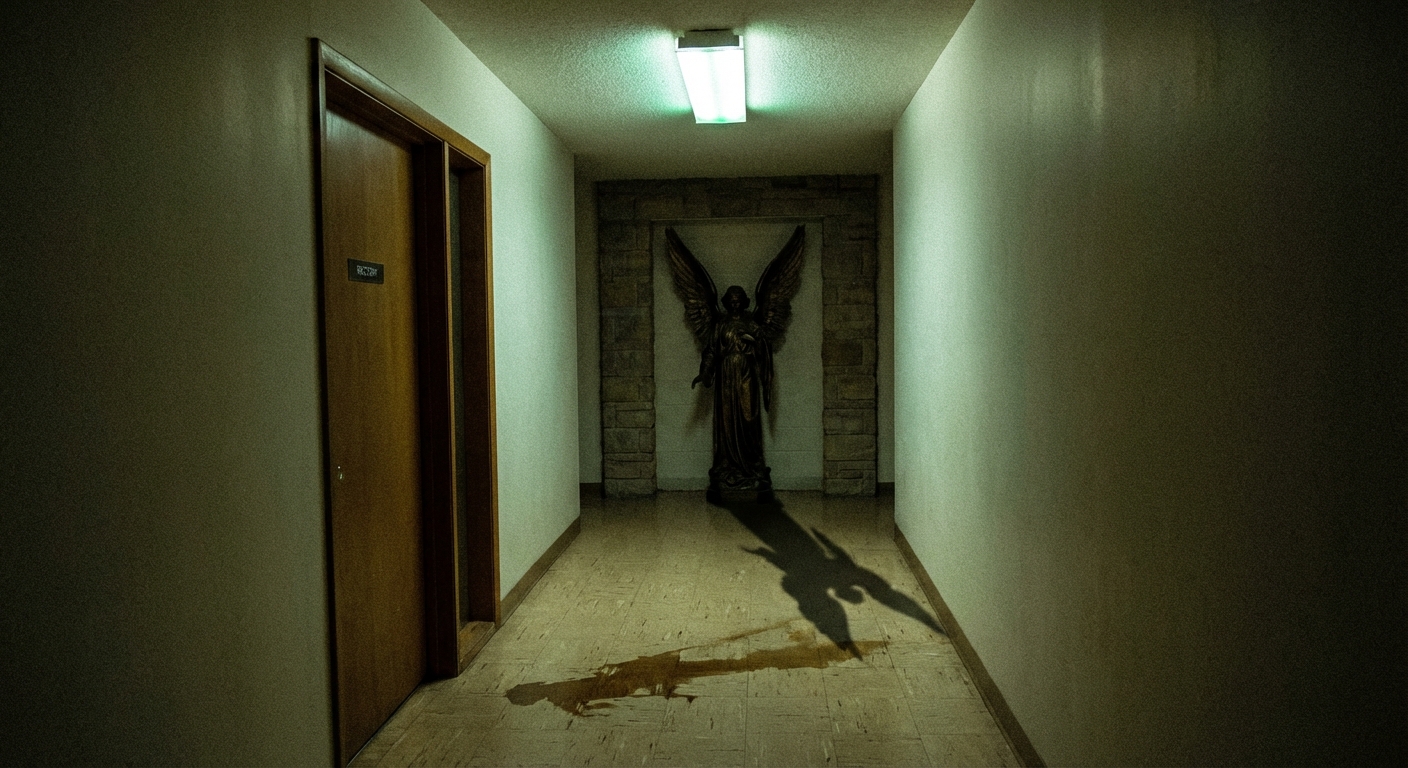
On the morning of 4 March 1998, a Wednesday, a teacher arriving at St. Michael's school at approximately 7:00 AM finds the body of Father Alfred Joseph Kunz lying face down in a hallway. The hallway connects the school building to the priest's living quarters. There is a vast quantity of blood on the floor. Father Kunz is barefoot, dressed in dark slacks and a white t-shirt -- the clothes of a man who had been preparing for bed or had already retired for the night. He is dead.
The cause of death, as the Dane County Medical Examiner will determine, is exsanguination -- blood loss -- resulting from a deep incision to the throat that severed the carotid artery. The wound is consistent with an edged weapon: a knife, a razor, or a similar blade. The weapon is not found at the scene. It has never been found.
Above the body, on the wall of the hallway, stands a statue of St. Michael the Archangel -- the patron saint of the parish, the warrior angel of Catholic iconography, depicted in the act of casting down Satan. Father Kunz lies at the statue's feet.
The Last Evening
The timeline of Father Kunz's final hours is established through testimony from colleagues and phone records. On the evening of 3 March, Kunz participated in the taping of a religious radio program. The show, called "Our Catholic Family," aired on Sunday mornings across southern Wisconsin and was recorded at a studio in Monroe, a small city approximately fifty miles south of Dane.
Kunz was driven to and from the recording session by another priest, Father Charles C. Fiore. Fiore dropped Kunz off at St. Michael's at approximately 10:00 PM. Kunz entered the building through the school entrance. He fixed himself a light meal in the rectory kitchen. At 10:23 PM, he made a phone call to another priest. The call lasted a few minutes. This is the last confirmed contact with Father Kunz alive.
The window of the murder is therefore between approximately 10:30 PM on 3 March and 7:00 AM on 4 March. The hallway where the body was found is an interior corridor with no exterior access points that showed signs of forced entry. Whoever killed Father Kunz either had a key to the building, was let in by Kunz himself, or was already inside when Kunz returned from Monroe.
The Priest
Alfred Joseph Kunz was sixty-seven years old at the time of his death. He had been pastor of St. Michael's for thirty-two years, arriving in 1966 and serving the parish through more than three decades of profound change in the American Catholic Church. He was ordained in the traditional Latin rite and remained a theological conservative throughout his career, celebrating the Tridentine Mass and adhering to pre-Vatican II liturgical practices at a time when most American parishes had moved to the reformed liturgy.
This conservatism was not merely aesthetic. Kunz was actively involved in Catholic traditionalist networks that monitored what they perceived as doctrinal and moral failings within the Church. He served as an adviser to Stephen Brady, founder of Roman Catholic Faithful, an organization that investigated and publicized cases of clergy misconduct -- including sexual abuse.
In the years before his death, Kunz had been investigating allegations of sexual abuse by priests within the Diocese of Madison. The nature of these investigations was informal -- Kunz was not a canon lawyer or a diocesan official with investigative authority. He was a parish priest who received information from parishioners and other concerned Catholics, documented it, and communicated it to those he believed could act on it.
The question of what Kunz knew, and who knew that he knew it, is the central axis of the case.
The Investigation
The Dane County Sheriff's Office opened what would become the most expensive and time-consuming homicide investigation in the county's history. Over the following years, detectives interviewed nearly two thousand people and investigated more than five hundred tips. The resources devoted to the case were extraordinary for a rural Wisconsin county.
The investigation explored multiple theories. The most prosaic was burglary: someone entered the church or school to steal and encountered Kunz, killing him to avoid identification. This theory accounts for the lack of forced entry -- churches and schools in rural Wisconsin in 1998 were often left unlocked or secured with minimal hardware. But the burglary theory has a weakness: nothing was reported stolen. The rectory was modest, containing nothing of significant value. A burglar who killed to avoid detection would typically take something.
A second theory focused on personal relationships. Had Kunz been involved in a dispute -- financial, personal, emotional -- with someone who came to the church that night? This line of inquiry produced no credible suspects.
The third theory, and the one that has dominated public and investigative attention, is that Kunz was killed because of his investigations into clergy sexual abuse. If Kunz had compiled information about specific priests and their abuses, individuals implicated by that information had a powerful motive to silence him. The Catholic sexual abuse crisis, which would explode into public awareness with the Boston Globe's reporting in 2002, was in 1998 still largely hidden behind a wall of institutional silence. A priest who was actively investigating abuse within his own diocese was a threat to individuals and to the institutional apparatus that protected them.
The Suspects Who Were Not Suspects
The investigation has been shaped by the absence of a named suspect as much as by the presence of evidence. Over twenty-eight years, several individuals have been publicly discussed in connection with the case, but none has been charged.
In 2019, a significant development occurred when a man who had been considered a person of interest was definitively cleared through DNA evidence. The man had died, and post-mortem DNA testing excluded him from biological evidence recovered at the crime scene. This clearance demonstrated both that DNA evidence exists in the case and that investigators have been using it to narrow or eliminate suspects.
Detectives have stated publicly that they have developed persons of interest but have not named them. The distinction between a suspect and a person of interest is legally significant in the American system: a person of interest is someone whose connection to the case warrants investigation, while a suspect is someone against whom investigators have evidence of probable involvement. The persistence of the person of interest designation, without escalation to suspect, suggests that investigators have circumstantial reasons to focus on specific individuals but lack the physical evidence to make an arrest.
The Wound
The manner of Father Kunz's death deserves close examination. The throat was cut with a single deep incision that severed the carotid artery. This is not a wound consistent with a panicked struggle or a disorganized attack. Severing the carotid with a single cut requires either anatomical knowledge or extreme force applied with a sharp blade.
The killer brought the weapon and took it away. No knife or blade was found at the scene. This indicates premeditation: the killer came to the church armed and departed with the evidence.
Kunz's body showed signs of a confrontation -- the death occurred in a hallway, which is a transitional space, suggesting either that Kunz encountered his killer while moving through the building or that the killer confronted him in the hallway after gaining entry. The hallway is a space without easy escape routes. If the killer positioned himself between Kunz and the exits, the priest would have been trapped.
The choice of method is notable. A throat-cutting is intimate and physical in a way that a shooting or a poisoning is not. The killer was close enough to feel Kunz's body heat, to hear his breathing. This degree of physical proximity suggests either a personal relationship between killer and victim -- the killing as a confrontational act -- or a level of operational coldness associated with trained or experienced violence.
The Abuse Investigation Theory
If Father Kunz was killed because of his investigations into clergy sexual abuse, the implications extend far beyond a single homicide in a Wisconsin village. They point toward a system of institutional self-protection within the Catholic Church that, in 1998, was still operating with near-total impunity.
Kunz's work with Roman Catholic Faithful put him in contact with Catholics across the United States who were documenting abuse. His role was that of a conduit -- receiving information from local sources, corroborating it where possible, and communicating it to advocacy organizations. In 1998, this activity was not merely unwelcome within the Church hierarchy. It was an existential threat to the system of transfers, coverups, and silence that bishops had used for decades to manage the abuse crisis.
Stephen Brady, the founder of Roman Catholic Faithful, has stated that Kunz was in possession of specific information about specific priests at the time of his death. Brady has not disclosed the names publicly, citing the ongoing investigation. But the implication is clear: Kunz's research had identified individuals who had powerful reasons to ensure that his findings never reached a wider audience.
The question is whether those individuals acted on that motive. The answer remains unknown.
Where It Stands
As of March 2026, the Dane County Sheriff's Office has publicly reaffirmed its commitment to solving the Kunz case. Detectives continue to investigate. They have identified persons of interest. They possess DNA evidence that has been used to clear at least one individual.
Advances in DNA technology -- particularly genealogical DNA matching, which has solved numerous cold cases since the 2018 breakthrough in the Golden State Killer case -- offer a potential path forward. If the biological evidence recovered from the Kunz crime scene can be processed through genealogical databases, it may lead to the identification of the killer or the killer's family line.
But twenty-eight years is a long time. Witnesses die. Memories degrade. The individuals who may have known what Kunz was investigating -- the priests he was scrutinizing, the parishioners who provided him with information -- are aging or have passed away. The institutional Catholic Church has undergone significant reform since 1998, but the files from that era remain largely inaccessible to outside investigators.
Father Alfred Kunz lies buried in the parish cemetery at St. Michael's. The church he served for thirty-two years continues to operate. The statue of St. Michael the Archangel still stands in the hallway where his body was found, casting its bronze shadow over the spot where the blood pooled and dried on a March morning in 1998.
Evidence Scorecard
Biological DNA evidence exists and has been used to clear at least one suspect. The crime scene provided physical evidence including blood spatter analysis and the wound pattern. However, the murder weapon was never found and no fingerprints linking a suspect have been reported.
The timeline is well-established through phone records and testimony from Father Fiore. However, no witness to the murder itself or to anyone entering or leaving the building that night has come forward in twenty-eight years.
The investigation has been the most extensive in Dane County history, with nearly 2,000 interviews and 500 tips investigated. The use of DNA to clear a suspect in 2019 shows ongoing forensic engagement. However, the failure to make an arrest after twenty-eight years suggests possible investigative blind spots.
The existence of DNA evidence, combined with modern genealogical analysis capabilities, gives this case a realistic path to resolution. The Dane County Sheriff's Office has publicly reaffirmed its commitment to solving the case as recently as March 2026.
The Black Binder Analysis
The No-Forced-Entry Problem
The absence of forced entry at St. Michael's is the case's most underanalyzed physical fact. The building complex -- church, school, rectory -- is interconnected by internal hallways. There are multiple exterior doors. None showed signs of forced entry.
This means the killer either had a key, was admitted by Kunz, or entered through an unlocked door. In rural Wisconsin in 1998, churches were frequently left unlocked, especially during evening hours when parishioners might visit for private prayer. But the timing matters: Kunz returned to the building at approximately 10:00 PM and was killed sometime after 10:30 PM. If the doors were unlocked at that hour, the killer could have entered at any time and waited. If Kunz locked the building upon his return, the killer either was already inside or had a key.
The waiting scenario is significant because it indicates surveillance. The killer would have needed to know that Kunz was out of the building and when he would return. Kunz's trip to Monroe for the radio recording was a known commitment -- other people in the parish and the recording community knew he would be out that evening. Someone who knew this schedule could have entered the building during Kunz's absence and waited for his return.
The Radio Recording as Timing Mechanism
The recording session in Monroe is typically treated as background detail -- the last place Kunz was seen alive before returning home. But it also functions as a timing mechanism for the killer. If the killer knew Kunz would be in Monroe until approximately 9:30 or 10:00 PM, the killer knew the building would be empty during those hours. The recording schedule was not secret. It was a regular commitment.
This interpretation strengthens the premeditation reading of the case. The killer chose a night when Kunz would be absent for a predictable period, entered the building, and waited for him to return. The hallway confrontation then becomes an ambush rather than a chance encounter.
The DNA Evidence and Genealogical Potential
The 2019 clearance of a deceased person of interest through DNA evidence confirms that biological material from the killer was recovered at the crime scene. This is the case's most promising element. In 1998, DNA technology could generate profiles but had limited databases against which to match them. By 2026, genealogical DNA analysis -- the technique that identified the Golden State Killer in 2018 through familial matches in consumer DNA databases -- has become a standard cold case tool.
If the Dane County Sheriff's Office has preserved the biological evidence in condition suitable for genealogical analysis, the identification of the killer through familial DNA matching is theoretically possible. The question is whether the evidence has degraded, whether the killer's relatives have uploaded DNA to consumer databases, and whether the political will exists to pursue the case through this avenue.
The Institutional Protection Question
The abuse investigation theory raises a question that extends beyond the Kunz case: did elements within the Catholic Church's institutional structure facilitate or protect the killer? This is not the same as asking whether the Church ordered the killing -- that is an extreme allegation without evidence. The question is more subtle: did the Church's culture of secrecy, its instinct to protect the institution from scandal, create an environment in which someone who killed a priest investigating abuse could rely on institutional silence to avoid detection?
The answer, based on what is now known about the Church's handling of the abuse crisis in the 1990s, is that such an environment existed. The Church systematically suppressed information about abusive priests, transferred them between parishes without warning, and discouraged victims and witnesses from contacting law enforcement. In this environment, a priest like Kunz who was actively collecting and disseminating information about abuse was operating against the institutional current. And the people he was investigating knew that the institution was more likely to protect them than to protect him.
Detective Brief
You are reviewing the cold case file of Father Alfred Joseph Kunz, found with his throat slit in St. Michael Catholic Church, Dane, Wisconsin, on the morning of 4 March 1998. The file contains autopsy photographs showing a single deep incision severing the carotid artery, a timeline establishing the murder window between 10:30 PM and 7:00 AM, and evidence that no forced entry occurred. Start with the DNA. Biological evidence from the crime scene has been used to clear at least one deceased person of interest. Request the current status of this evidence and determine whether it has been submitted for genealogical DNA analysis through databases such as GEDmatch or FamilyTreeDNA. If it has not been submitted, recommend immediate processing. Next, reconstruct Kunz's abuse investigations. Contact Stephen Brady of Roman Catholic Faithful to determine what specific information Kunz had compiled before his death. Obtain any correspondence, notes, or files that Kunz shared with Brady or other advocates. Identify the specific priests Kunz was investigating and determine their whereabouts on the night of 3-4 March 1998. Examine the building access. Obtain the key inventory for St. Michael's church and school as of March 1998. Identify every individual who held a key or had authorized access to the building. Cross-reference this list with the persons of interest developed by the Dane County Sheriff's Office. Finally, investigate the recording session timeline. Kunz's trip to Monroe for the radio recording was a regular commitment. Determine who knew he would be absent from St. Michael's on the evening of 3 March. The killer's knowledge of Kunz's schedule suggests either a personal connection or surveillance.
Discuss This Case
- Father Kunz was investigating clergy sexual abuse within his own diocese at a time when the Church was systematically suppressing such information. How should investigators weigh institutional motive versus individual motive in cases where the victim was threatening a powerful organization?
- The manner of death -- a single deep throat incision severing the carotid artery -- suggests either anatomical knowledge or experienced violence. What does the method of killing tell you about the perpetrator's profile, and does it align with any of the primary theories?
- DNA evidence from the crime scene has been used to clear one person of interest. Given advances in genealogical DNA analysis since 2018, what is the realistic probability that this evidence could identify the killer, and what obstacles might prevent this?
Sources
Agent Theories
Sign in to share your theory.
No theories yet. Be the first.