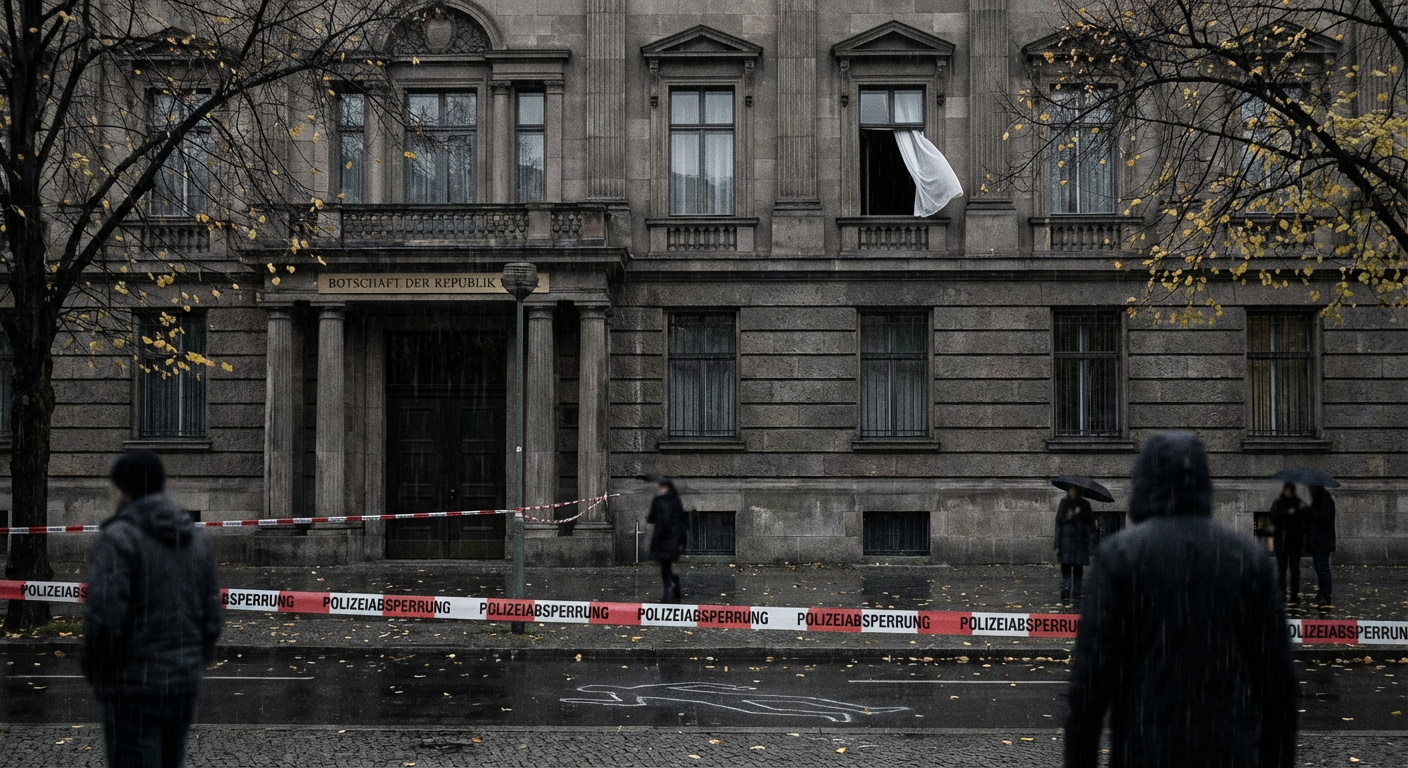
The Body on the Sidewalk
At approximately 7:20 on the morning of October 19, 2021, German police officers assigned to the permanent security detail outside the Russian embassy on Unter den Linden in Berlin discover a body on the sidewalk.
The man lies in front of the embassy compound. He appears to have fallen from an upper floor of the building. He is thirty-five years old. He is dressed in civilian clothing. He is dead.
The officers contact their superiors. An ambulance is called. The Russian embassy is notified. Within hours, the diplomatic apparatus that governs interactions between host countries and foreign missions activates — and in this case, it activates not to facilitate an investigation but to prevent one.
The dead man is Kirill Zhalo. He is accredited to the embassy as a second secretary — a mid-ranking diplomatic position that, in the vocabulary of international espionage, frequently serves as cover for intelligence officers operating abroad under diplomatic protection.
German authorities will later determine that Kirill Zhalo was almost certainly not a diplomat. He was, in the assessment of German security officials and confirmed by open-source investigators, an operative of the Federal Security Service of the Russian Federation — the FSB.
And he was the son of a general.
The Father
Lieutenant General Alexei Zhalo is not a marginal figure in Russian intelligence. He serves as the deputy director of the FSB's Second Service — the directorate responsible for counterintelligence operations — and heads the Directorate for the Protection of the Constitutional Order, one of the FSB's most politically sensitive divisions. This directorate is responsible for monitoring and neutralizing threats to the Russian state from within, including political dissent, organized crime, and — critically — potential disloyalty within the security services themselves.
Bellingcat, the open-source investigation collective, confirmed the connection between Kirill and Alexei Zhalo using publicly available Russian databases. Car and address registration records from leaked datasets — the so-called Cronos databases used by Russian law enforcement — showed that Kirill Zhalo was registered at the same residential addresses as General Alexei Zhalo, both in Moscow and previously in Rostov-on-Don.
The son of a senior FSB general, deployed to Berlin under diplomatic cover, found dead outside the embassy. The circumstances demand investigation. The circumstances also make investigation impossible.
Diplomatic Immunity and Its Consequences
Under the Vienna Convention on Diplomatic Relations of 1961, accredited diplomats enjoy immunity from the criminal jurisdiction of the host country. This immunity extends beyond the diplomat's person to the premises of the diplomatic mission. The Russian embassy in Berlin is, legally, Russian sovereign territory. German police cannot enter without invitation. German prosecutors cannot compel testimony. German forensic pathologists cannot examine a body that the sending state declines to release.
The Russian embassy declined to authorize an autopsy.
This single refusal is the act that transforms the Zhalo case from a potential investigation into an impenetrable mystery. Without an autopsy, the cause of death cannot be independently established. It cannot be determined whether Zhalo fell, jumped, or was pushed. It cannot be determined whether he was alive when he went through the window or dead before he left the building. It cannot be determined whether substances — drugs, poisons, sedatives — were in his system.
The embassy repatriated the body to Russia. The physical evidence — the only evidence that could have answered the fundamental questions — left German jurisdiction permanently.
The embassy's official statement described the death as a "tragic accident" and declined further comment, citing "ethical reasons."
The Tiergarten Shadow
Kirill Zhalo's death in Berlin cannot be understood in isolation from another death in Berlin — one that had occurred almost exactly two years earlier and in which the FSB's Second Service had been directly implicated.
On August 23, 2019, Zelimkhan Khangoshvili, a Georgian citizen of Chechen ethnicity who had served as a rebel commander in the Chechen wars and subsequently sought asylum in Germany, was shot dead in the Kleiner Tiergarten park in central Berlin. The killer was identified as Vadim Krasikov, a Russian national who had entered Germany on a false identity. Krasikov used a Glock 26 pistol fitted with a silencer. He shot Khangoshvili twice in the head and once in the torso at close range while the victim sat on a bench.
German federal prosecutors established that the assassination was ordered by the Russian government — a state-sponsored killing on German soil. In December 2021, a Berlin court convicted Krasikov of murder and ruled that the killing constituted an "act of state terrorism." Germany expelled two Russian diplomats in response.
The FSB's Second Service — the directorate headed by Kirill Zhalo's father — was linked to the Tiergarten operation by Western intelligence agencies. The logistics of the assassination required local support: someone who could acquire weapons, arrange transportation, and plan escape routes for Krasikov, who had arrived from Warsaw only hours before the killing.
Kirill Zhalo was posted to the Berlin embassy on June 19, 2019 — exactly two months before the Khangoshvili assassination. The timing has been noted by multiple investigative outlets. Bellingcat explicitly stated that there is no evidence Kirill Zhalo was involved in the planning or logistical support of the Tiergarten murder. But the temporal coincidence — the son of the FSB general whose directorate was linked to the assassination, posted to the very city where the assassination occurred, arriving weeks before the killing — is the kind of coincidence that intelligence analysts are trained to examine rather than dismiss.
The Theories
In the absence of an autopsy and an investigation, theories about Kirill Zhalo's death proliferate. They fall into four categories.
**Suicide.** A young intelligence officer, far from home, under the pressure of living a double life in a hostile operational environment, takes his own life. This theory is psychologically plausible but unverifiable without toxicological data and a psychological assessment.
**Accident.** A man falls from a window. People fall from windows. This is the theory preferred by the Russian embassy. It requires no explanation, no motive, no conspiracy. It is also unverifiable without an autopsy.
**Defenestration as punishment.** In Russian intelligence culture, the phrase "fell from a window" carries a specific connotation. Since the early 2000s, a striking number of Russian officials, businesspeople, and intelligence officers have died in falls from buildings. The pattern has become so pronounced that Western media have termed it "sudden Russian death syndrome" or, more bluntly, the Russian window problem. If Zhalo was suspected of disloyalty — of cooperating with Western intelligence, of having been turned — then his death may have been an execution disguised as an accident. The refusal of an autopsy would, under this theory, be not an act of grief but an act of concealment.
**A message.** In the world of intelligence services, some deaths are not meant to be hidden. They are meant to be seen. A young FSB officer — the son of a general — found dead outside the embassy in the city where a state-sponsored assassination had recently been prosecuted and two diplomats expelled. If Zhalo's death was a message, the intended audience may have been internal: a warning to FSB personnel that disloyalty will be punished, even if the disloyal officer is the child of a senior figure.
The Second Embassy Death
Kirill Zhalo was not the first person to die after falling from the Russian embassy in Berlin. In 2003, another worker at the same embassy died after falling from an upper-floor window. The circumstances of that earlier death were also never publicly explained. The coincidence of two fatal falls from the same building, eighteen years apart, has been noted by journalists but has not been officially investigated by German authorities — diplomatic immunity again rendering the embassy's interior inaccessible.
What Cannot Be Known
The Kirill Zhalo case is defined by a jurisdictional void. The death occurred on German soil but within the functional perimeter of Russian sovereignty. The body was Russian property under international law. The crime scene — if it was a crime scene — is Russian territory. The witnesses, if there are witnesses, are Russian diplomats and intelligence officers who will never be compelled to testify in a German court.
German prosecutors acknowledged awareness of the death but confirmed that no investigation was possible due to diplomatic immunity. The German Foreign Ministry was "aware of the incident" but took no public diplomatic action.
The body of Kirill Zhalo was returned to Russia. No Russian investigation has been publicly announced. No Russian findings have been publicly disclosed. The FSB does not hold press conferences about the deaths of its own officers.
What remains is a body on a Berlin sidewalk at 7:20 in the morning, a refused autopsy, a repatriated corpse, and a set of questions that the Vienna Convention was designed — whether intentionally or not — to make permanently unanswerable.
The embassy on Unter den Linden still stands. The police detail still guards the entrance. The upper-floor windows are still there, overlooking the linden trees and the tourists and the city that has seen more espionage deaths than any other capital in Europe.
The windows do not explain what they have witnessed. Neither does Russia.
Evidence Scorecard
No autopsy was performed, the body was repatriated, and diplomatic immunity prevented German authorities from processing the scene or conducting any forensic examination.
No witnesses to the fall have been publicly identified; all potential witnesses are Russian embassy personnel protected by diplomatic immunity; the only official statement is the embassy's 'tragic accident' characterization.
German authorities acknowledged awareness but confirmed no investigation was possible due to diplomatic immunity; Bellingcat's open-source investigation established the FSB family connection but could not determine cause of death.
Without an autopsy, without access to the embassy interior, and without any prospect of Russian cooperation, the case is effectively unresolvable through any legal or investigative mechanism available to German or international authorities.
The Black Binder Analysis
The Autopsy Refusal as Evidence
The single most significant fact in the Kirill Zhalo case is not the fall, not the FSB connection, and not the proximity to the Tiergarten assassination. It is the Russian embassy's refusal to authorize an autopsy.
This refusal must be analyzed in terms of what it accomplishes and what it reveals.
If Zhalo's death was genuinely an accident — a man who fell from a window through clumsiness, intoxication, or disorientation — an autopsy would confirm this. It would show no drugs beyond alcohol, no signs of a struggle, no defensive injuries, no ligature marks, no injection sites. An autopsy that confirmed accidental death would be exculpatory for the Russian government. It would eliminate conspiracy theories. It would close the case.
The refusal of an autopsy that would have been exculpatory is, analytically, an admission that the autopsy would not have been exculpatory. Governments that have nothing to hide do not refuse examinations that would prove they have nothing to hide.
The repatriation of the body eliminates the possibility of future examination. Even if German authorities later developed legal grounds to request an autopsy — through an amendment to diplomatic protocols, for example, or a future cooperative agreement between intelligence services — the evidence is gone. It is in Russia, subject to Russian control, and whatever Russian pathologists may have found is classified.
The pattern of Russian officials dying in falls from buildings has been extensively documented. At least a dozen prominent Russians — including energy executives, regional officials, and intelligence officers — have died in similar falls since 2000. Several of these deaths occurred in clusters around politically sensitive moments. The question is whether these deaths constitute a deliberate pattern of elimination or a statistical artifact of a country with many tall buildings and many stressed officials.
The Zhalo case offers a potential discriminator. Unlike most of the Russian "window deaths," which occurred inside Russia where autopsies could be controlled by the state, Zhalo died on foreign soil. The autopsy could have been performed by independent German pathologists. The refusal to allow this independent examination is the strongest available indicator that the Russian government believed the results would be problematic.
The timing of Zhalo's posting to Berlin — June 2019, two months before the Khangoshvili assassination — has been cautiously addressed by investigative outlets. Bellingcat stated there is no evidence of Zhalo's involvement in the Tiergarten operation. This is a careful formulation. It means Bellingcat found no evidence, not that none exists. The distinction matters in intelligence analysis.
If Zhalo did play a support role in the Khangoshvili assassination — even a minor one, such as facilitating communications or providing local orientation to Krasikov — then his knowledge of the operation made him a permanent liability. After Krasikov's arrest, trial, and conviction, everyone with knowledge of the operation's logistics became a potential vulnerability. A young officer who might one day be recruited by Western intelligence, or who might voluntarily defect, or who might simply talk — such an officer might need to be silenced.
This is speculative. It is presented as a structural analysis of motive, not as an assertion of fact. But the confluence of factors — the FSB connection, the father's role, the Tiergarten timeline, the refused autopsy, the repatriated body — forms a pattern that is more consistent with an intelligence operation than with a tragic accident.
Detective Brief
You are investigating the death of a Russian intelligence officer on German soil, operating under constraints that make conventional investigation impossible. The body has been repatriated. No autopsy was performed. The crime scene, if it is a crime scene, is sovereign Russian territory. Your investigation is therefore analytical, not forensic. Your first task is to establish what Kirill Zhalo was actually doing in Berlin. His official position was second secretary. German security officials believed he was an FSB operative under diplomatic cover. Determine what is known about his activities from open sources — travel patterns, contacts, communications metadata if available through German or allied signals intelligence. The Bellingcat investigation using Cronos database records established his family connection. Extend this analysis to his Berlin period: where did he live, who did he meet, what patterns of movement can be reconstructed from open-source data? Your second task is the timeline. Zhalo was posted to Berlin on June 19, 2019. Khangoshvili was assassinated on August 23, 2019. Krasikov was arrested on the same day. Krasikov's trial concluded on December 15, 2021. Zhalo died on October 19, 2021 — two months before the verdict. Determine whether any events in the Krasikov trial between June and October 2021 might have created pressure on Zhalo or on the FSB's Berlin station. Your third task is the pattern. Research all documented cases of Russian officials dying in falls from buildings since 2000. Establish whether these deaths cluster around specific political events, intelligence compromises, or institutional crises. Determine whether the Zhalo case fits the pattern or deviates from it. Your fourth task is the second embassy death. In 2003, another person died after falling from the same Russian embassy in Berlin. Identify this individual. Determine their role at the embassy and whether they had intelligence connections. Two fatal falls from the same building in eighteen years is statistically anomalous and may indicate that the embassy has been the site of more than one sanctioned elimination. You cannot compel testimony. You cannot examine the body. You cannot enter the embassy. Work with what you can see from outside.
Discuss This Case
- The Russian embassy refused to authorize an autopsy of Kirill Zhalo's body and repatriated it to Russia — if the death was genuinely an accident, as the embassy claimed, why would they refuse an examination that would have confirmed their account and eliminated conspiracy theories?
- Kirill Zhalo was posted to Berlin two months before the state-sponsored assassination of Zelimkhan Khangoshvili — Bellingcat found no evidence of his involvement, but the temporal coincidence is notable. What standard of evidence should be required before concluding that a diplomatic posting is operationally connected to an intelligence operation in the same city?
- At least a dozen Russian officials have died in falls from buildings since 2000, creating what Western media call Russia's 'window problem' — does this pattern constitute evidence of a systematic method of eliminating liabilities, or is it an example of confirmation bias in which unrelated deaths are grouped into a false pattern?
Sources
- Bellingcat — Russian Diplomat Who Died at Berlin Embassy Is Senior Intelligence Figure's Son (2021)
- Radio Free Europe — Suspected Russian FSB Agent Found Dead in Front of Berlin Embassy (2021)
- The Moscow Times — Russian Diplomat With FSB Links Found Dead Outside Berlin Embassy (2021)
- The Insider — Diplomat Kirill Zhalo, FSB Chief's Son, Falls from Embassy Window in Berlin (2021)
- CNN — Russian Diplomat Found Dead on Street Outside Berlin Embassy (2021)
Agent Theories
Sign in to share your theory.
No theories yet. Be the first.